The Cord That Never Came Down
Seasonal readiness, November 2026
The Halloween lights are still taped up in the break room. The power bar behind the reception desk is still feeding six things at once, the way it did the night of the party. The candy bowl is still sitting on the counter, half empty, because nobody decided when it should go. None of it was meant to stay. All of it is still here, days later, because nobody told it to leave.
That is how most electrical hazards actually arrive. Nobody plans to overload a circuit or run a cord across a walkway all winter. It starts as one string of lights for one evening, one extra lamp because the afternoons are dark now, one space heater because a desk near the window has gotten cold. Each addition may look small and reasonable on its own. None of them were ever removed, checked, or accounted for.
November is when the season’s real driver shows up: the days keep shortening, and workplaces keep adding things that draw power and weren’t there in September. A cord left on the floor is not dangerous because it is decorative. It is dangerous because it is a cord, on a floor, carrying current, and it will still be dangerous in December if nobody looks at it before then.
Temporary electrical arrangements have a habit of quietly becoming permanent.
This issue is about the everyday load nobody adds up, and the boundary nobody should cross without being qualified to.
What's Changing This Season
Daylight keeps shrinking, and workplaces keep responding the same quiet way: another lamp, another heater, another cord run to reach an outlet that was never meant to serve this many things at once.
Not Just the Shop Floor
An extension cord does not become harmless because it is under an office desk. The setting changes the level of risk, not electricity’s ability to shock, overheat, or start a fire.
The Everyday Hazards Hiding in Plain Sight
The everyday load nobody adds up
Nobody plans an overloaded circuit. It just accumulates.
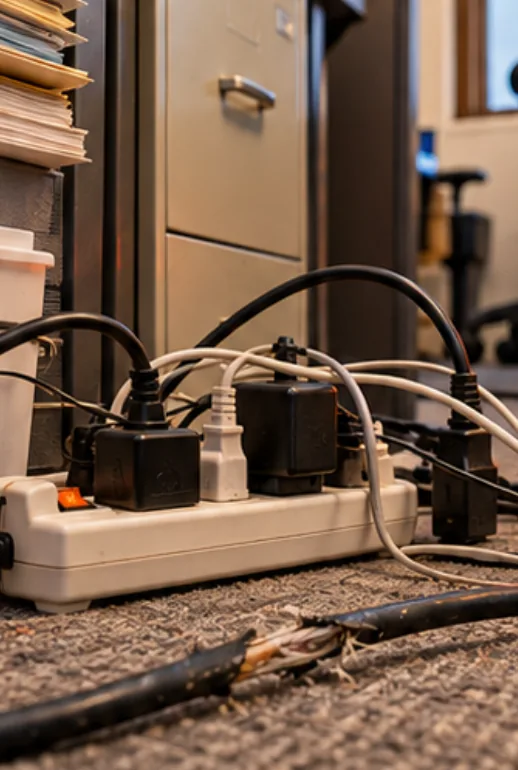
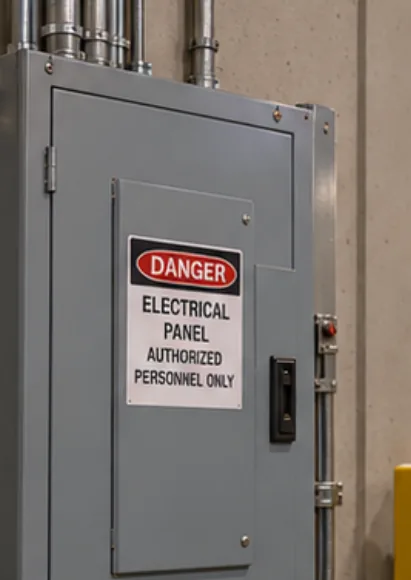
Most electrical incidents in an ordinary workplace do not involve anyone doing electrical work. They involve a cord that has been stepped on so many times the insulation has split, a power bar with three other power bars plugged into it, an extension cord doing a job it was never rated for, a space heater tucked against a stack of paper, or an electrical panel with a filing cabinet quietly pushed in front of it over the course of a year.
None of these require a mistake by an electrician. They require nobody looking. A frayed cord gets noticed and used anyway because replacing it means finding the receipt, filing the request, waiting for the new one. A blocked panel stays blocked because the cabinet had to go somewhere and that corner looked empty. The hazard is not exotic. It is the ordinary object nobody has looked at since it was installed.
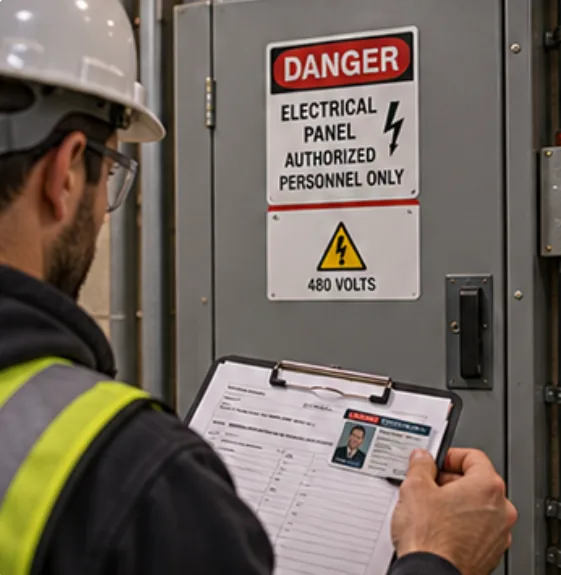
Any worker may stop using suspect equipment, warn others, and report it. If it can be done safely, disconnect it from power and mark it out of service. Repair, testing, alteration, and re-energization must be completed only by a person qualified and authorized under the applicable law and workplace procedure. A worker who spots the hazard is not necessarily the person who fixes it.
The Law, Where You Work
Ontario, industrial establishments
Regulation 851 requires electrical equipment, insulating materials, and conductors to be suitable for their use and certified by the Canadian Standards Association or the Electrical Safety Authority. Cord-connected equipment and tools must have an adequately grounded casing unless properly double-insulated. Portable electrical tools used outdoors or in wet locations must be protected by a ground fault circuit interrupter. Any ground fault that may pose a hazard must be investigated and removed without delay. Ontario construction sites fall under a separate regulation, O. Reg. 213/91.
British Columbia
WorkSafeBC guidance distinguishes a “qualified electrical worker,” who must satisfy the requirements applicable to the work under British Columbia’s Safety Standards Act and Electrical Safety Regulation, from the broader term “qualified,” meaning knowledgeable about the work, its hazards, and the means of controlling them through education, training, experience, or a combination of these. The terms are not interchangeable, and neither should automatically be replaced with “electrician.”
Federally regulated workplaces
The Canada Occupational Health and Safety Regulations provide that, where feasible, the design, construction, and installation of electrical equipment must meet the Canadian Electrical Code, while its operation and maintenance must meet that Code. Testing or work on electrical equipment must be performed by a qualified person or an employee under that person’s direct supervision.
Everywhere else
Every jurisdiction not named here still carries the same general duty and its own adopted edition of the electrical code. CCOHS provides national guidance, but guidance is not legislation. The requirements of the governing jurisdiction always prevail.
A worker who spots the hazard is not necessarily the person who fixes it.
The Boundary
Coverage beyond housekeeping
A person can be qualified and still be killed when the system was never confirmed dead.
Most of what sits under a desk or behind a reception counter is a housekeeping problem, not a trades problem. But every so often, the everyday cord-and-heater world touches the other side of electrical safety: work on equipment that is, or might still be, energized. That is where the stakes change completely, and where being qualified is not the same as the work being done safely.
Show Me The Fines
Two court cases and one investigation. Three examples of electrical safety failures.
A Kitchener-based company, O’Connor Electric Ltd., had three workers install a disconnect switch in an electrical room at a shopping mall in January 2018, believing the system had already been shut down. It had not. An arc flash burned all three. The company and a supervisor pleaded guilty. The company was fined $55,000 and the supervisor $5,000, plus the mandatory 25 percent victim fine surcharge. These were electrical workers. What failed was isolation, verification, and supervision, not qualification.
A worker for Otter Energy Inc. died after leaning against a metal roof frame that had become energized through an undetected ground fault, caused by a pinched wire in one panel of a 25-panel solar array. The Ministry found the employer had failed to take every reasonable precaution to prevent hazards to workers from energized electrical equipment. The company was fined $50,000 under the Occupational Health and Safety Act and Ontario Regulation 213/91, and $50,000 under the Electricity Act, plus the surcharge. The danger was invisible. That is exactly why the case matters.
Langford, British Columbia
Technical Safety BC investigation, 2024
A worker was modifying fluorescent fixtures at a major retailer when a fault caused a partial outage. Later that night, another worker, unqualified for the task, troubleshot the still-energized panel and caused an arc fault that burned their face and hands. The investigation found that worker had been supervised by someone using fraudulent certifications. Three other people in the store suffered minor smoke inhalation.
A certificate is evidence only after it has been verified. Confirm the licence, certification, scope, and current standing with the responsible authority before regulated work begins.
A person can be qualified and still be killed when the system was never confirmed dead in the first place.
November Readiness Checklist: Electrical Safety
Due diligence record: confirm it, sign it, file it
Visually inspect it. Confirm who’s qualified. Sign it. File it. The PDF version of this issue has the lines to sign and date it.
Section A: The everyday load
Section B: Access and qualification
Section C: Preparing for the season
Your November Action Plan
Nothing stays temporary unless someone decides it does.
Walk your workplace and name what’s still there from a season that’s already ended.
The decor, the extra cord, the heater someone brought from home.
Visually inspect every cord, power bar, and accessible receptacle you can reach.
Anything damaged comes out of service today, not next week.
Confirm your panel access is clear
And confirm who in your workplace is actually authorized to repair or re-energize anything electrical.
Any worker can stop using suspect equipment, warn others, and report the hazard.
If it can be done safely, the equipment may be disconnected and marked out of service. Only a qualified and authorized person may repair, test, alter, or re-energize it.
A cord that’s been checked and a cord that’s been assumed safe look identical until one of them fails.
Temporary electrical arrangements have a habit of quietly becoming permanent, not because anyone decides to leave them, but because nobody decides to take them down. A string of lights, a borrowed heater, a cord run across a walkway, each one arrives with an end date in mind and stays long after that date has passed.
The line between an everyday hazard and a serious one is not complicated. Most of what sits under a desk is a housekeeping problem, waiting to be noticed. The moment anything crosses into energized work, it is no longer everyone’s job. It is the job of the person who is qualified and authorized to do it.
October’s first aid question did not stop mattering because the calendar changed. While you check cords and panels this month, make sure your workplace can still answer the earlier question:
who is covering today?
Before you put this newsletter down, walk one hallway or one storage room and look for the thing that’s still plugged in from a season that’s already over.