Home / Newsletter / The Weight of a Short Crew

SHORT STAFFING | FATIGUE | SAFE LIFTING

The Weight of a Short Crew

August is about the loads people lift when there is nobody to help.

Issue

August 2026

Published by

OMHAS Solutions Inc.

Topics

Short staffing, fatigue, safe lifting

Reading time

About 10 minutes
The Weight of a Short Crew OMHAS | Outsourced Management for Health and Safety | Canada
By August, the crew is thin. People are on vacation, shifts are covered by whoever is available, and the ones who are left are carrying more than their share. And somewhere in that stretch, a worker looks at a load that should take two people, decides there is nobody to ask, and lifts it alone.
That is the moment this newsletter is about. Not a dramatic accident. A quiet decision, made under pressure, that a body pays for later.

“A quiet decision, made under pressure, that a body pays for later.”

Musculoskeletal injuries, the strains and sprains and back injuries that come from lifting, carrying, pushing, and pulling, are the most common workplace injury in the country. They rarely arrive as a single dramatic event. They build, one awkward lift and one rushed carry at a time, until a worker cannot straighten up. And they climb in the summer, when crews are short and the pressure to just get it done is highest.
This month we want to talk about three things that belong together: the pressure that makes people take the risk, the slow injury that follows, and the controls that actually prevent it. Read this newsletter. Complete the checklist. File it as a due diligence record. And before your crew works short again this summer, make sure nobody is being set up to move a two-person load on their own.

The Pressure Behind the Injury

Manual handling injuries are not only about weight. They are about the conditions people lift in. A short crew means no second person to call. Vacation coverage means less experienced hands on unfamiliar tasks. Overtime and long days mean fatigue, and a tired worker lifts with worse technique and slower judgment. And the worry people carry from home, the kids, the childcare gaps, the things left unfinished, does not stay at the door. It adds to the fatigue and the distraction that put a back at risk. None of this is an excuse. All of it is a risk factor you can plan for.

Not Just Heavy Lifting

It is easy to picture this as a warehouse or a construction problem. It is not. A cleaner wringing and hauling mops and buckets, a caregiver repositioning a resident, a cook lifting stockpots and cases, an office worker carrying boxes of files, a delivery driver reaching and twisting all day, all of them are doing manual material handling, and all of them are at risk of the same injuries. The question is not whether your people lift heavy things. It is whether anywhere in your workplace someone lifts, carries, pushes, or pulls in a way that could hurt them, especially when they are short-handed, rushed, or tired. If the answer is yes, this newsletter is about you.

The Injury That Builds

The Slow Injury

Most lifting injuries are not one bad lift. They are a hundred of them.

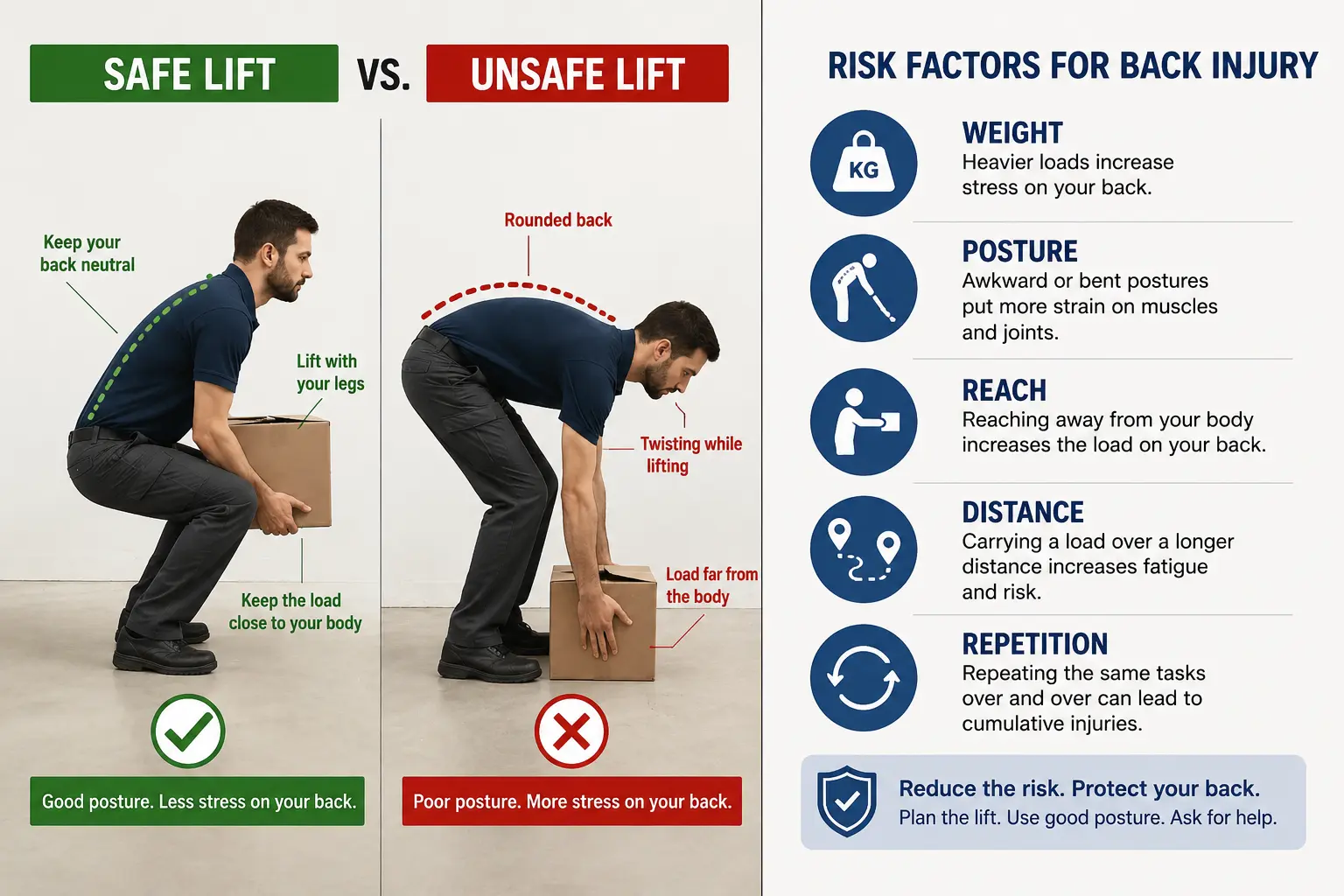
Weight posture reach distance and repetition the five risk factors that multiply each other OMHAS | Outsourced Management for Health and Safety | Canada
Weight, posture, reach, distance, and repetition: the five risk factors that multiply each other.
The dangerous thing about manual handling is that it usually does not hurt you today. A worker lifts a load that is a little too heavy, or bends and twists to reach it, or carries it a little too far, and nothing happens. So they do it again tomorrow, and the day after. The strain accumulates in the back, the shoulders, the neck, the wrists, until one ordinary lift is the one that tears something.
That is why manual handling is so easy to underestimate and so expensive to ignore. The risk does not announce itself. It is spread across weeks of small overloads, and it is worst exactly when conditions are worst: a heavy or awkward load, a low or overhead reach, a long carry, a repetitive task done all shift, and a worker who is tired, rushed, or working alone. Every one of those factors multiplies the others. A manageable lift with a full crew and a fresh worker becomes an injury when the crew is short and the worker is on their tenth hour.

What the Law Requires

No province sets a single maximum weight a worker may lift, because a safe lift depends on the whole task, the weight, the size, the shape, how often, and how it is handled. Instead, the law requires the employer to assess manual handling tasks, identify the risk of injury, and eliminate or reduce it, engineering and equipment first, then how the work is organized, then training. Under the general duty in every provincial OHS Act, the employer must take every reasonable precaution to protect a worker from a foreseeable hazard, and a musculoskeletal injury from a task you already know is heavy or awkward is about as foreseeable as a hazard gets.

The Law, Where You Work

Summer Shortcuts That Cost

Most manual handling injuries begin with a sentence someone says to themselves.

Every one of these is the sound of a short crew under pressure. None of them is a control. The job that needs two people, or a cart, or a rest, needs it just as much in August as in any other month.

“A manageable lift with a full crew becomes an injury when the crew is short.”

What Actually Works: Show Me the Fines

The Controls That Work

Technique matters least. Everything before it matters more.

Ask most workplaces about lifting safety and they will point to a poster about bending your knees. Technique is real, but it is the last and weakest line of defence. The controls that actually prevent injury come before a worker ever touches the load, and they work in order.
  1. Eliminate or reduce the handling. The safest lift is the one nobody has to do. Deliver closer to the point of use, store heavy items between knee and shoulder height, break loads down, and cut the carry distance.
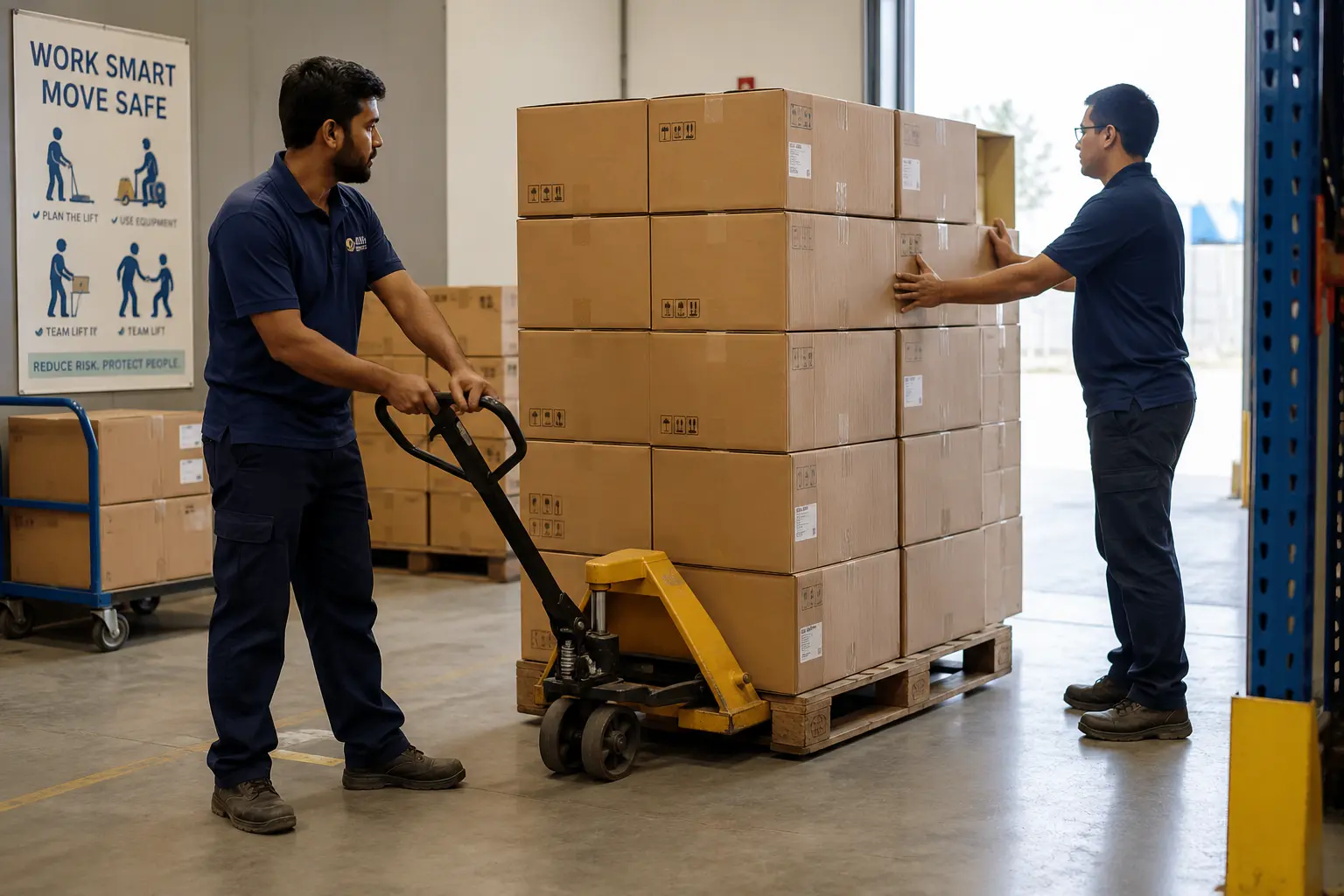
  2. Put mechanical aids first, and within reach. Carts, dollies, hand trucks, pallet jacks, hoists, and lift tables. Confirm they are present, working, and not locked in a back room. An aid nobody can reach is not a control.
  3. Use team lifts, and mean it. For loads that need two, a team lift is the rule, not a favour a busy worker feels bad asking for. That only holds if the crew is staffed so a second person actually exists.
  4. Manage the workload and the schedule. Match the work to the crew you have. Do not leave the heavy tasks for the shortest shift, build in rest, and watch for the fatigue that short-staffing and long days create.
  5. Train, then supervise. Workers need training on technique and on the aids, and supervisors need to watch for the quiet shortcut when people are rushing to finish. Then write it down, because the record is your due diligence.

“The safest lift is the one nobody has to do.”

Two cases. One injury one death. The same pressure underneath OMHAS | Outsourced Management for Health and Safety | Canada

Two cases. One injury, one death. The same pressure underneath.

Hawksville, Ontario · Incident February 2024 · Fined 2025

A young worker at a heavy equipment plant was moving steel. To lift a steel tube, about half an inch thick and roughly 682 pounds, they used a magnetic lifting device hung from an overhead crane. As the worker stood in the aisle between two storage racks, the tube came off the magnet and dropped about two feet to the floor, causing serious injury. The investigation found the worker had not been adequately trained on the crane or the magnetic lift, and was not accompanied or instructed by a competent person. The company pleaded guilty and was fined $65,000, plus a victim surcharge.
The lift was mechanical, but the failures were human: no training, no competent person watching, a young worker left to move a heavy load alone. Those are exactly the gaps that open when a crew is short and everyone is busy.

Vancouver, British Columbia · Incident February 2024 · Penalties issued 2025

Yuridia Flores was forty-one. She was working at a highrise under construction when a large formwork platform being moved on an upper level broke loose, fell from the 26th floor, and struck her. She was killed. The failures were plain: workers were regularly moving and standing beneath suspended loads, the ground exclusion zone had not been properly set or controlled, and there was no critical lift plan for the work. Her employer was penalized $112,624.66 and the prime contractor $514,831.53.
No one works or stands under a suspended load, and the ground beneath a moving load is kept clear and controlled, every time. The penalties in this case are under review. The death, and the reasons for it, are not.

The numbers, because this is not rare.

Musculoskeletal injuries are the most common workplace injury in Canada. According to provincial workers’ compensation data, in British Columbia they drove approximately 88,000 time-loss claims and more than 2.35 billion dollars in cost over five years, and in Ontario they account for more than 40 percent of all lost-time injuries. And regulators are looking: WorkSafeBC named musculoskeletal injury a key inspection focus for 2026, and Ontario’s ministry has run ergonomics and material-handling inspections into this year. This is the hazard they are inspecting for right now.

Due Diligence Record: Complete, Sign, and File

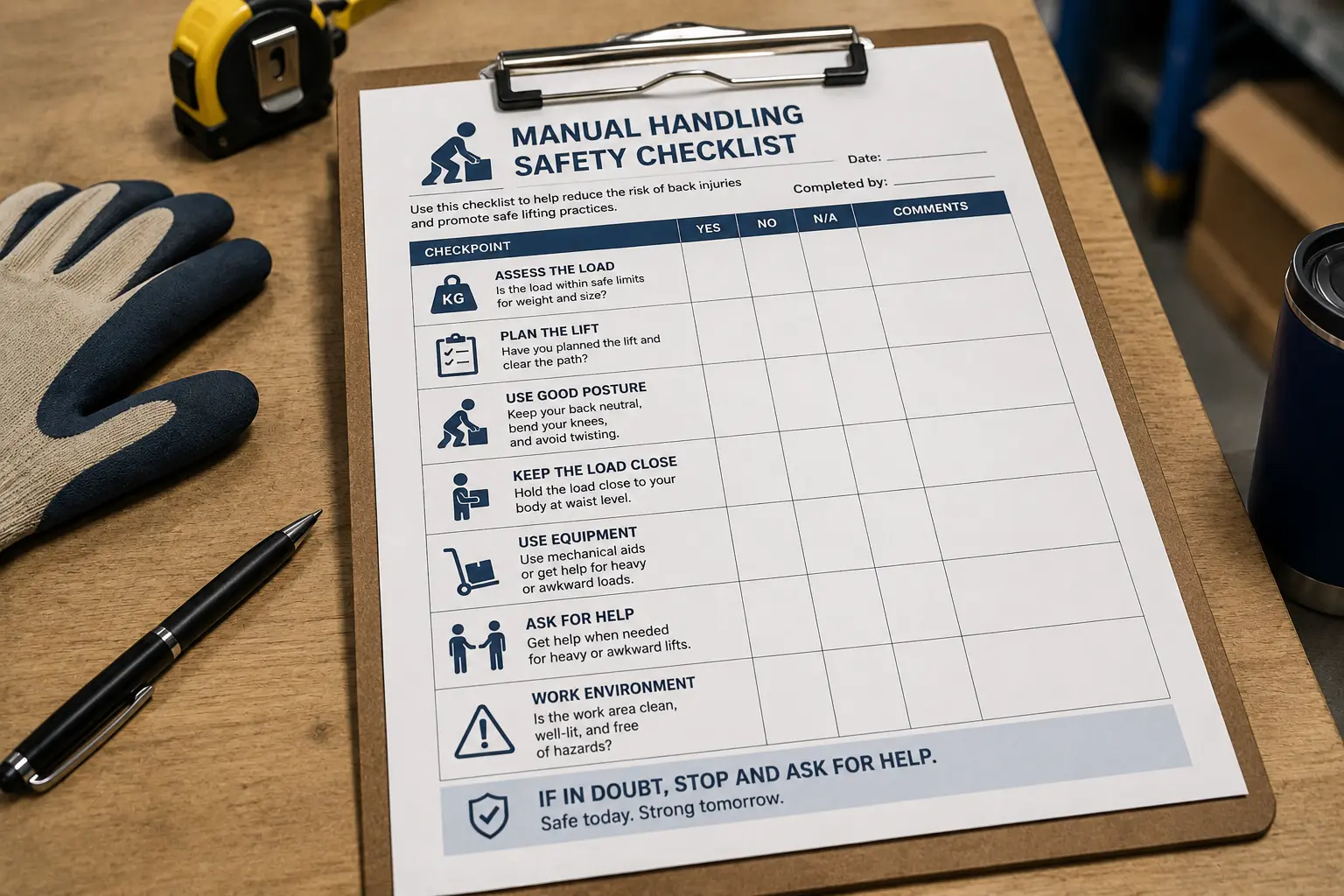
August Readiness Checklist: Manual Handling and Short-Staffed Work

Complete this before the summer crunch peaks. Sign it. Date it. File it.

A completed and signed checklist is your due diligence record evidence that the work was planned before anyone lifted OMHAS | Outsourced Management for Health and Safety | Canada
A completed and signed checklist is your due diligence record, evidence that the work was planned before anyone lifted.

Section A: Assessing the Work and the Workload

Section B: Safe Handling and Mechanical Aids

Section C: Training, Supervision, and Records

This checklist is a due diligence record.

Keep a signed copy on file. It is evidence that manual handling risks were properly assessed and controlled. Download the print version below to complete, sign, and file.

Due Diligence Record: Five Steps Before the Crunch

Your August Action Plan

Five steps before the summer crunch peaks.

  1. Walk your site and list the lifting. Find every task where someone lifts, carries, pushes, or pulls, and mark the loads that are heavy, awkward, low, overhead, or repeated all day. Those are the ones that hurt people.
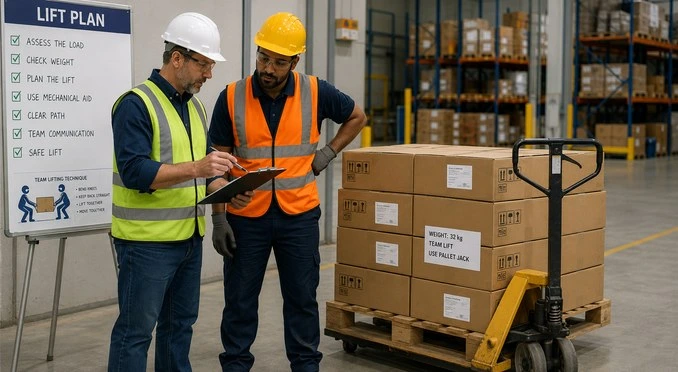
  2. Assess those tasks for the summer you are actually in. A lift that is fine with a full crew is a different lift when two people are on vacation, the worker is tired, and there is nobody to call for a hand. Put the high-risk ones through a hazard assessment that accounts for the thin crew and the pressure.
  3. Put the mechanical aids first, and out where people will use them. Carts, dollies, pallet jacks, hand trucks, hoists. Confirm they are present, working, and not locked in a back room. An aid nobody can reach is not a control.
  4. Match the work to the crew you have, not the crew you wish you had. Set team-lift rules for loads that need two, adjust the schedule so heavy work is not left to a short shift, and make clear that waiting for a second person is the expectation, not a failure.
  5. Train, supervise, and write it down. Confirm workers know safe technique and the team-lift rule, ask supervisors to watch for the quiet shortcut when people are rushing to get home, and record what you did. Sign it, date it, file it. That record is your due diligence.
A planned lift is a safe lift. End the summer on competence and teamwork OMHAS | Outsourced Management for Health and Safety | Canada
A planned lift is a safe lift. End the summer on competence and teamwork.
Manual handling injuries are almost never caused by a single mistake. They are caused by a season of small ones. One lift alone. One skipped cart. One shift too short. One worker too tired to lift the way they know they should. Each looks minor on its own. Together, over a summer, they are how a strong worker ends up unable to straighten their back.
The good news is that every one of those small decisions can go the other way. A staffed crew means a second set of hands. An aid within reach means the load never rides on a spine. A realistic schedule means nobody is lifting on empty. Break enough of those links, and the injury that was building never arrives.
Before you put this newsletter down, answer one question. Somewhere in your workplace, is there a task where a worker, short-handed and tired, would be tempted to lift something alone that really needs two people or a machine? If you are not certain, that uncertainty is your answer. Go and find out.
So sit down with your supervisors this month. Walk your own floor. Find the lifts that get harder when the crew runs thin, and for each one ask the question this whole newsletter is built around: what could hurt someone here, and what have we done so the worker who lifts it in August can still lift it in September? That conversation, documented and filed, is what keeps your people healthy and your business protected.

Take it with you

Download this issue as a PDF to print, circulate, or file as a due diligence record.

Need help now?

Talk to an OMHAS advisor about manual handling risk and short-staffed work in your operation.

Two programs built for exactly this hazard.

As your health and safety adviser, OMHAS maintains a complete library of health and safety programs, and every one of our maintenance clients has access to all of them. Two fit this month: Ergonomics and Manual Lifting (OHS-PROG-23) is built for exactly this hazard, and Job Hazard Analysis and Risk Assessment (OHS-PROG-10) puts a short-staffed summer task under a proper assessment before it puts someone on a claim. Both are yours for the asking. If you read this and recognize a task that fits, reach out, and we will put the program in your hands.

(226) 271-6039  |  omhas@omhas.ca  |  www.omhas.ca