Every year, in workplaces across Canada, workers die in confined spaces that looked perfectly safe.
Most of them never expected the space to kill them. Some were cleaning it. Some were inspecting it. Some were retrieving a dropped tool. The task was routine. The space was familiar. And many of them never came back out.
A confined space does not announce itself. It does not look like a hazard. That is exactly what makes it one.
Summer is when these spaces get opened. The tanks get cleaned, the silos get emptied, the pits and vaults and sewers and manholes get entered, all the quiet corners of a facility that nobody touches for eleven months of the year. The work is ordinary. The risk is not.
This month we want to talk about three things that belong together: how to recognize a confined space and why every entry needs a permit, the atmosphere you cannot see and how to test for it, and the rescue plan that must exist before anyone goes in, because the person who climbs in to save a collapsed coworker is the one most likely to die next.
“A confined space does not look like a hazard. That is exactly what makes it one.”
Three Questions
Before anyone treats a space as ordinary, ask three questions about it.
If the answer to all three is yes, stop. Treat it as a confined space, and assess it before anyone enters. Tanks, silos, vats, pits, vaults, sewers, manholes, boilers, ducts, hoppers, and storage bins almost always qualify. So do the ones people forget: a crawl space under a building, the inside of a large machine, a trench deep enough to trap the air.
A JHA is not a form filled out after the work is done. It is a thinking exercise that happens before anyone picks up a tool, enters a space, or begins a task for the first time or under new conditions. In summer, new conditions are everywhere: heat, humidity, outdoor environments, changing site configurations, new workers, and subcontractors unfamiliar with your hazards. Every one of these is a reason to conduct a JHA before the work begins.
Not Just Farms and Construction Sites
It is easy to read a confined space warning and assume it is meant for someone else. Heavy industry. Agriculture. Crews working underground. It is not.
A law firm or a bank may have a records vault large enough to walk into, with a door that locks from the outside and no handle on the inside. A restaurant has walk-in coolers and sometimes a grease pit. An office building has electrical rooms below grade, an elevator pit, and utility tunnels. A manufacturer has mixers, ovens, hoppers, and tanks that a worker has to climb inside to clean. Some of these are textbook confined spaces. Others, like a walk-in freezer that cannot be opened from the inside, pose the same danger in a different form: a worker shut into a space that can harm them, with no easy way out.
So the question is not what industry you are in. It is this. Somewhere in your workplace, is there a space a worker could enter and not easily get out of, a space that could overcome them or trap them while they are inside? If the answer is yes, you have a confined space, and the rest of this newsletter is about you.
The Atmosphere You Cannot See
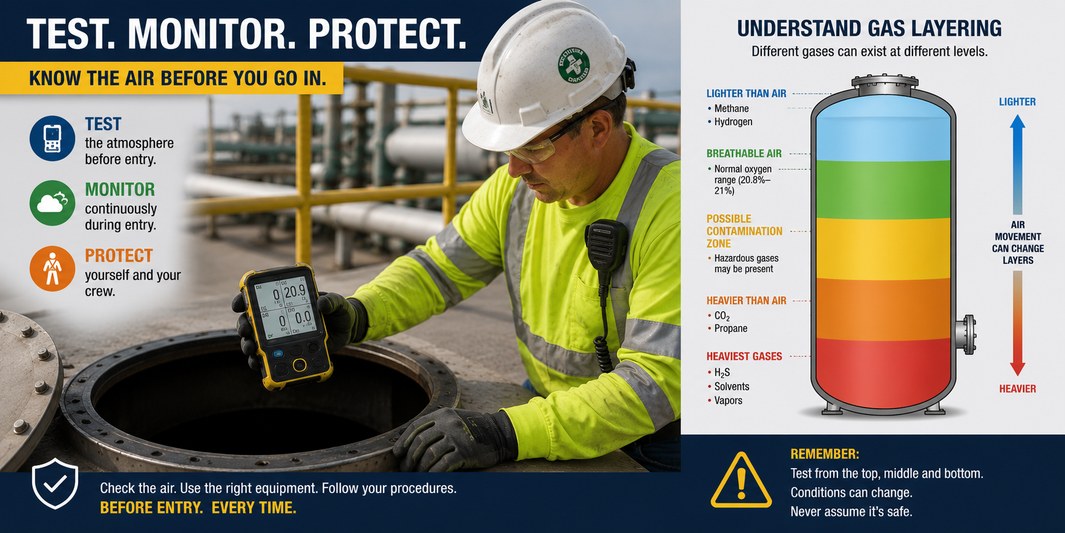
Most confined space deaths are not falls or crushing. They are the air.
The most dangerous thing about a confined space is the one thing a worker cannot see, smell, or feel until it is too late. The atmosphere.
A confined space can hold too little oxygen, consumed overnight by rust forming on steel walls, by decomposing material, or by a gas that settled in and pushed the breathable air out. It can hold too much of something else: hydrogen sulphide from sewage or decay, carbon monoxide from an engine running nearby, methane, solvent vapours, the residue of whatever the space last held. Some of these gases kill in seconds. Some are flammable. Most give no warning a person can detect on their own.
A worker who steps into an oxygen-deficient space does not gasp and climb out. They lose consciousness, often without ever knowing anything was wrong. That is why the air must be tested before entry and monitored continuously during the work, by an instrument and not by a nose.
Summer makes this worse, not better. Warm months are when most maintenance entries happen, so more workers go into these spaces in July than at any other time of year. Heat adds strain on a worker already inside a poorly ventilated space, and higher temperatures can drive more vapour off any residue or liquid the space still holds. More entries, in harder conditions, is the summer pattern.
“The air must be tested by an instrument, not by a nose.”
What the Law Already Requires
There is no single national confined space law in Canada. The requirements live in provincial OHS regulations, and they vary in their detail. But the spine is the same everywhere. An employer must identify confined spaces, assess the hazards of each one in writing, control those hazards before entry, and put a written entry procedure in place. Under the general duty clause in every provincial OHS Act, the employer must take every reasonable precaution to protect a worker from a known and foreseeable hazard. The hazards of a confined space are among the most foreseeable in any workplace. They are written into the space itself.
The Law, Where You Work
Wherever you operate, the core duties are the same: identify the spaces, assess them, control the hazards, permit the entry, and plan the rescue.
Eight Key Steps to Compliance
- Assessment. Every confined space is identified and assessed in writing by a competent person before any entry is planned.
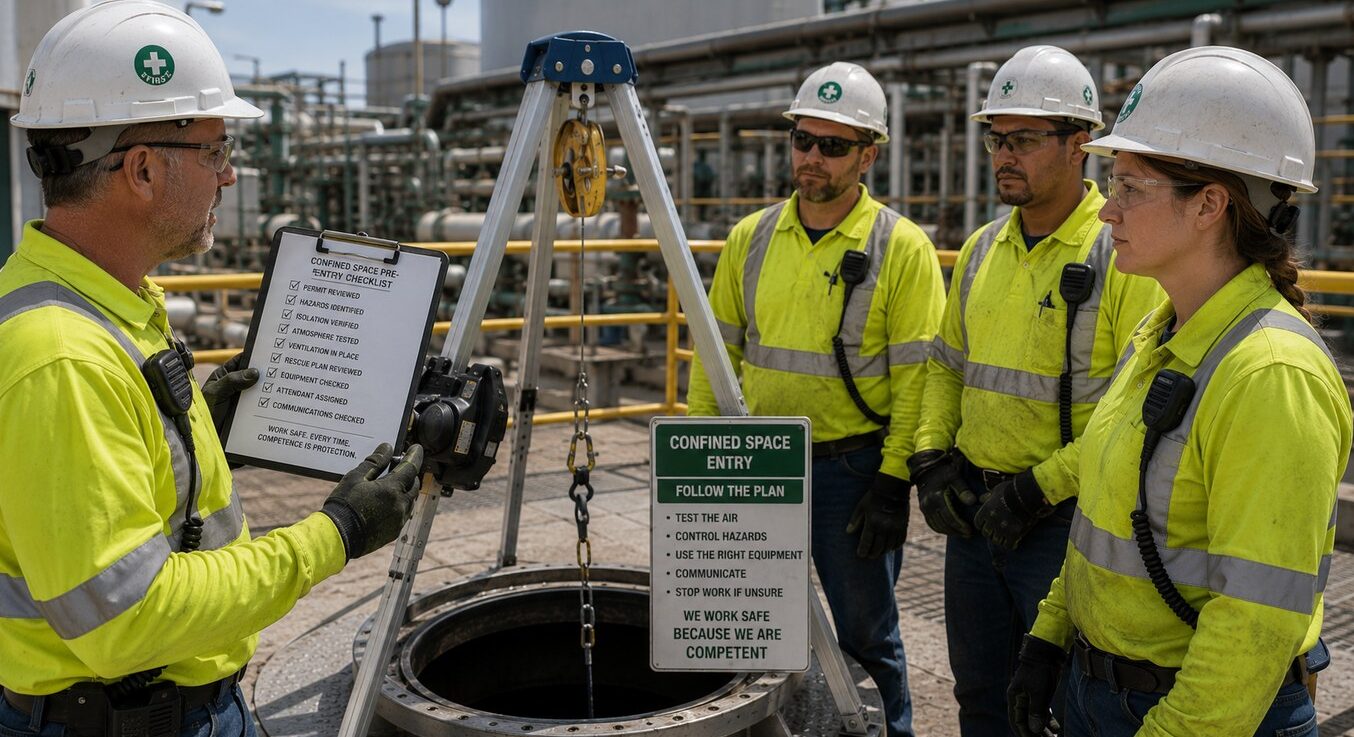
- Permit. No one enters without a written entry permit naming the space, the hazards, the controls, the people involved, and the time it is valid.
- Testing. The atmosphere is tested before entry with a calibrated instrument, in order: oxygen, combustible gases, then toxic contaminants.
- Monitoring. The atmosphere is monitored continuously while the work is underway. Conditions inside can change in minutes.
- Ventilation. Where the atmosphere is not safe on its own, mechanical ventilation is used to make it safe, and testing confirms it worked.
- Attendant. A trained attendant stays outside the space for the entire entry, in constant communication with the worker inside, and does not leave for any reason.
- Rescue. A rescue plan and rescue equipment are in place before entry begins.
- Training. Every person involved- the entrant, the attendant, the supervisor- is trained for their role before the work begins.
Dangerous Assumptions
Every confined space fatality begins with one of these.
Not one of these is a substitute for testing the air and following the entry procedure. The space does not care what you assume about it.
Rescue Readiness: Show Me the Fines
The Rescue That Becomes the Tragedy
The most dangerous moment in a confined space is the moment someone goes in to help.
Here is the pattern that repeats, year after year, in confined space deaths across Canada and around the world. A worker enters a space. Something goes wrong. They collapse. A coworker sees it and does the most human thing imaginable. They go in after them. And then there are two.
In confined space fatality investigations, the original entrant is very often not the only victim. Coworkers and supervisors attempting a rescue frequently become casualties themselves, because they go in with no air monitoring, no breathing protection, and no plan, while someone they know lies motionless a few feet away and every instinct says go.
This is why a rescue plan is not paperwork. It is the difference between one tragedy and several. Before anyone enters a confined space, the answer to one question must already exist, in writing, on site: if the worker inside collapses right now, how do we get them out without sending another person in to die? If your only plan is for a coworker to climb in, you do not have a plan. You have a second casualty waiting to happen.
A real rescue plan names the method, the equipment, the retrieval lines and harnesses and the means to pull a worker out from outside the space, the trained people, and the call for emergency services. It is rehearsed, not imagined. And the standby attendant who would summon it never, under any circumstances, becomes the rescuer by entering the space.
Three Cases. Three Provinces. One Pattern.
Mississauga, Ontario · Incident Dec 2022 · Sentenced 2026
Three workers were inside an underground chamber, servicing a damaged watermain as part of sewer system work, when the main burst and flooded the chamber. Two escaped. The third, fifty-four-year-old Joaquim Silva, did not. His body was recovered the next morning, after firefighters pumped the water out. The company pleaded guilty to criminal negligence causing death and was fined $225,000, with a victim surcharge of $67,500 and a further order to pay $200,000 in restitution to the worker’s widow. A project supervisor was fined $50,000.
The hazard was a sudden release of water into an enclosed space with limited exit. A confined space assessment asks exactly that before the work begins: what could fill this space, or trap a worker in it, and how do we get out if it does?
Quesnel, British Columbia · Incident Jan 2025 · Penalty 2026
A fire had broken out inside a sawmill silo, and the water used to put it out left the wood fibre inside frozen in place. A subcontracted worker, twenty-four years old, was pressure washing that fibre from inside the silo when a large volume of it broke loose from an overhang, blocked the hatch, and engulfed him. He was killed. The regulator found that no adequately trained person had been put in charge of the confined space entry program, that no proper hazard assessment or pre-entry inspection had been done, and that the rescue arrangements failed at every level: the harness was not tied to a lifeline held by a standby person, the standby worker had no means to lift him out, the rescue crew was untrained, and the required annual rescue drills had never been run.
The company was fined almost $111,000.
Fredericton, New Brunswick · Incident Aug 2018 · Conviction upheld 2025
Michael Henderson was eighteen years old, freshly out of high school, working inside the hole at the centre of a concrete clarifier at a wastewater plant. His supervisor was running a leak test on a pipe that fed into that hole, holding the water back with an inflatable plug, and never told Henderson it was happening. The plug let go. Thousands of litres of water flooded the hole and pinned the teenager against the wall until it rose over his head. Coworkers, including his own brother, tried to reach him. He drowned. The supervisor had never identified the hole as a confined space, never assessed it, and never built a rescue plan beyond having someone there to pull the worker out. He was convicted of criminal negligence causing death and sentenced to three years in prison, a sentence the Court of Appeal upheld in 2025. The company pleaded guilty to a health and safety charge of its own.
This is the case no fine can capture. Sometimes the consequence is not a penalty against a company. It is a person in a cell.
Three spaces. One flooded by a burst main, one packed with engulfing fibre, one flooded by a test nobody was warned about. Three industries, three provinces, and underneath them the same root causes: a space never properly recognized or assessed, no one clearly responsible for the entry, and no rescue plan that could have worked.
“Your hazards must be communicated to every person who steps onto your site before they begin work.”
Due Diligence Record: Complete, Sign, and File
July Readiness Checklist: Confined Space Entry
Complete this before any confined space work this summer. Sign it. Date it. File it.
Section A: Identifying Confined Spaces, Permits, and Program Oversight
Section B: Atmospheric Testing and Ventilation
Section C: Rescue and Standby
This checklist is a due diligence record.
Keep a signed copy on file. It is evidence that entry was properly planned and authorized before any worker went in. Download the print version below to complete, sign, and file.
Five Steps Before the Season
Your July Action Plan
Five steps before the summer maintenance season is fully underway.
- Walk your site and list every confined space. Tanks, pits, vaults, sewers, silos, crawl spaces, large equipment. If you are not sure whether something counts, treat it as a confined space until a competent person confirms otherwise.
- Pull your confined space program. Confirm each space has a written hazard assessment and a current entry procedure. If you do not have one, July is the month to build it, before the cleaning and maintenance work begins.
- Check your gas detector. Confirm it is calibrated, charged, and that the people who would use it know how. An instrument nobody can operate is not a control.
- Confirm your rescue plan. For every space someone might enter this summer, ask the hard question out loud: if a worker collapses inside, how do we get them out without sending someone in after them? If you cannot answer it, do not authorize the entry.
- Complete the checklist above. Sign it. Date it. File it. If an inspector visits, or if something goes wrong, that signed record is evidence that you took the entry seriously before anyone went in.
Confined space fatalities are almost never caused by a single mistake. They are caused by a chain of small decisions. No assessment. No testing. No permit. No attendant. No rescue plan. Each link looks minor on its own. Together, they are how a routine task becomes a fatal one.
The good news is that every link in that chain can be broken before anyone enters the space. An assessment breaks the first one. A gas test breaks the next. A permit, an attendant, a rescue plane- each one breaks another. Break enough of them, and the worker comes home.
Before you put this newsletter down, answer one question. It is the same one we opened with. Somewhere in your workplace, on a farm, on a shop floor, or behind a locked door in a quiet office, is there a space a worker could enter and not easily get out of, a space that could overcome them or trap them while they are inside? If you are not certain, that uncertainty is your answer. Go and find out.
So sit down with your supervisors this month. Walk your building, not someone else’s. Find the spaces a person could be trapped or overcome in, and for each one ask the question this whole newsletter is built around: what could go wrong in here, and what have we done so that the worker who goes in this summer comes back out? That conversation, documented and filed, is what keeps your people alive and your business protected.